John W. Belmont, MD, PhD, FAAP, FACMG
Expert Consulting

Scope of Services
Market Intelligence
Diagnostics for Rare Disease
Genetic Screening, PGx, and Polygenic Scores
Critical Literature Review
Research Planning and Study Design
Data Analysis and Visualization
Scientific Writing
Professional Review of Planned Projects
Partner in Implementation and Health Economics Research
Experience in Medical Genetics Practice, Research, and Applied Genomics
Deep Experience
Immunology (PhD), Pediatrics (American Board of Pediatrics), and Medical Genetics (American Board of Medical Genetics). Thirty years in medical practice at Texas Children’s Hospital one of the most respected pediatric facilities in the world. Five years as Senior Principal Medical Scientist at Illumina, Inc. the leading manufacturer of genomics instruments and applications.
Advanced Research Skills
Continuously funded basic and translational research. Know-how in clinical trial design and analysis for diagnostics and rare diseases. Research experience in complex traits and infectious diseases. Founder and Vice President of Seqwright, Inc. a successful commercial sequencing services company.
Challenging the Status Quo
Constantly monitoring the literature for publications that change our understanding of human genetics, medical genetics, and precision medicine. Paying special attention to Causal Inference applied to genomics.
Why Should We Do Genetic Testing?
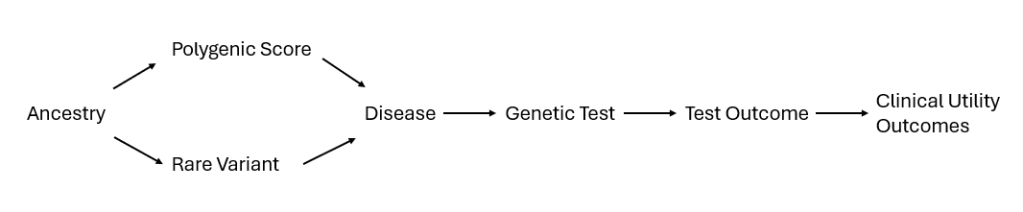
If a doctor orders a genetic test, will it have Clinical Utility? It’s a surprisingly difficult question to answer. Will patient outcomes be improved because the test allowed the doctor to make a better diagnosis? The diagram (as a directed acyclic graph – DAG – that lends itself to causal modeling) shows an ideal process in which getting a genetic test gives a clinically useful result that improves management and outcome. In the blog below I discuss how one can measure clinical utility. It’s of great practical importance that doctors select patients with signs and symptoms suggestive of genetic disease for genetic testing. The entire path has to be understood through the lens of that selection.
Profile and Track Record
Dr. Belmont is a physician-scientist with extensive experience in medical practice, academic research, and the biotechnology industry.
Dr. Belmont was formerly Senior Principal Medical Scientist on the Medical Genomics Research team at Illumina, Inc. This company is a major manufacturer of instruments used for genome sequencing. Within Illumina, Dr. Belmont consulted on diverse programs including studies of the clinical utility of genome analysis, software development to improve genome interpretation, and standards for clinical genome sequencing. Dr. Belmont also has experience as an entrepreneur having co-founded Seqwright, Inc. with Dr. Richard Gibbs in 1994 and serving as VP until its sale in 2012.
Dr. Belmont is the author of more than 250 peer-reviewed publications, book chapters, and invited articles with >45,000 citations . Along with his daily consulting work, Dr. Belmont also continues to conduct research on birth defects, cardiovascular disorders, and infectious diseases as complex genetic traits. He has a particular interest in the genetic causes of congenital cardiovascular malformations and other inborn errors of development. Dr. Belmont was an Assistant Investigator in the Howard Hughes Medical Institute (1987-1993) one of the most prestigious research organizations in the world. He achieved the rank of Professor (with tenure) in the Departments of Molecular and Human Genetics and Pediatrics at Baylor College of Medicine. He was Principal Investigator on numerous NIH and foundation grants with sustained multi-grant funding over a 28 year period. He also taught a storied graduate course in Human Genetics in the Department of Molecular and Human Genetics at Baylor College of Medicine (BCM). His commitment to graduate education is illustrated by his participation in over 100 thesis advisory committees. He has served on numerous research study sections most recently the NIH Genetics of Health and Disease and the Center for Inherited Disease Research (Chair, 2024-present) review committees. He was a founder and Associate Director of the Cardiovascular Research Institute (CVRI) at BCM. Under his leadership, the CVRI developed an innovative genetic testing strategy for cardiovascular disorders which has since been incorporated into the Baylor HeartCare testing initiative.
In addition to his research, Dr. Belmont is a Pediatrician and Medical Geneticist. He had a 28-year practice at Texas Children’s Hospital in Houston, Texas. He has a long-standing interest in the genetic causes of developmental and cardiovascular diseases. His clinical work included evaluation of infants, children and adolescents with birth defects, intellectual disability, and cardiovascular disorders. He was a co-founder in 1997 of the Cardiovascular Genetics Clinic at Texas Children’s Hospital and worked with some of the best Pediatric Cardiologists in the U.S. over an 18 year period.
Dr. Belmont grew up in San Antonio, Texas and received a B.A. degree from the University of Texas, Austin in 1974. He attended Baylor College of Medicine where he graduated with M.D. and Ph.D. degrees in 1981. After Pediatrics training at Children’s Hospital National Medical Center, Washington, D.C. he returned to Baylor for post-doctoral research in genetics. He joined the faculty of Baylor College of Medicine in 1987. He is a diplomate of the American Board of Pediatrics and the American Board of Medical Genetics. He is a member of the American Society of Human Genetics, American College of Medical Genetics, and an elected member of the Society for Pediatric Research, American Society for Clinical Investigation and Association of American Physicians.
John is an advocate for children’s health and biomedical research. He was Chair of Economics of Genetics Services Committee of the American College of Medical Genetics from 2023-2025. A current focus of advocacy is to introduce whole genome sequencing into clinical practice.
How can I help your program?
Learn about Medical Genetics and other subspecialty practices who care for patients with genetic disorders
Understand the landscape of professional organizations and their role in practice guidelines.
Define which patients are most likely to benefit from genetic testing
Use medical coding to find specific patient populations and investigate unmet needs
Confirm constraints on product use and reimbursement
Develop executive and external presentations
Plan your roadmap for evidence development.
Scope your primary objectives and design effective clinical trials
Identify the key influencers in the field
Assemble your KOL advisors
Understand the impact of exemplar publications
Develop a Precision Medicine plan for your health system or company
Identify and mitigate the obstacles to implementation
Selected Recent Publications:
1. The Causal Pivot: A structural approach to genetic heterogeneity and variant discovery in complex diseases Chad A. Shaw, C.J. Williams, Taotao Tan, Daniel Illera, Nicholas Di, Joshua Shulman, John W. Belmont. The American Journal of Human Genetics,
2025, ISSN 0002-9297, https://doi.org/10.1016/j.ajhg.2025.07.012.
2. A meta-analysis of diagnostic yield and clinical utility of genome and exome sequencing in pediatric rare and undiagnosed genetic diseases. Pandey R, Brennan NF, Trachana K, Katsandres S, Bodamer O, Belmont J, Veenstra DL, Peng S.Genet Med. 2025 Feb 25;27(6):101398. doi: 10.1016/j.gim.2025.101398. PMID: 40022598
2. The impact of clinical genome sequencing in a global population with suspected rare genetic disease. Thorpe E, Williams T, Shaw C, Chekalin E, Ortega J, Robinson K, Button J, Jones MC, Campo MD, Basel D, McCarrier J, Keppen LD, Royer E, Foster-Bonds R, Duenas-Roque MM, Urraca N, Bosfield K, Brown CW, Lydigsen H, Mroczkowski HJ, Ward J, Sirchia F, Giorgio E, Vaux K, Salguero HP, Lumaka A, Mubungu G, Makay P, Ngole M, Lukusa PT, Vanderver A, Muirhead K, Sherbini O, Lah MD, Anderson K, Bazalar-Montoya J, Rodriguez RS, Cornejo-Olivas M, Milla-Neyra K, Shinawi M, Magoulas P, Henry D, Gibson K, Wiafe S, Jayakar P, Salyakina D, Masser-Frye D, Serize A, Perez JE, Taylor A, Shenbagam S, Abou Tayoun A, Malhotra A, Bennett M, Rajan V, Avecilla J, Warren A, Arseneault M, Kalista T, Crawford A, Ajay SS, Perry DL, Belmont J, Taft RJ.Am J Hum Genet. 2024 Jul 11;111(7):1271-1281. doi: 10.1016/j.ajhg.2024.05.006. Epub 2024 Jun 5.PMID: 38843839
3. Development of a comprehensive cardiovascular disease genetic risk assessment test. Amendola LM, Coffey AJ, Lowry J, Avecilla J, Malhotra A, Chawla A, Thacker S, Taylor JP, Rajkumar R, Brown CM, Golden-Grant K, Hejja R, Lee JA, Medrano P, Milewski B, Mullen F, Walker A, Huertez-Vasquez A, Longoni M, Perry DL, Hostin D, Ajay SS, Kesari A, Strom SP, Margulies E, Belmont J, Lanfear DE, Taft RJ.medRxiv [Preprint]. 2024 May 9:2024.05.06.24306379. doi: 10.1101/2024.05.06.24306379.PMID: 38766118
4. Evidence review and considerations for use of first line genome sequencing to diagnose rare genetic disorders. Wigby KM, Brockman D, Costain G, Hale C, Taylor SL, Belmont J, Bick D, Dimmock D, Fernbach S, Greally J, Jobanputra V, Kulkarni S, Spiteri E, Taft RJ.NPJ Genom Med. 2024 Feb 26;9(1):15. doi: 10.1038/s41525-024-00396-x.PMID: 38409289
5. The Expansion of Genetic Testing in Cardiovascular Medicine: Preparing the Cardiology Community for the Changing Landscape. Reza N, Alford RL, Belmont JW, Marston N.Curr Cardiol Rep. 2024 Mar;26(3):135-146. doi: 10.1007/s11886-023-02003-4. Epub 2024 Jan 26.PMID: 38277082
What is the Clinical Utility of a Genetic Test?
 belmontgenetics.org